
Playground Automation and CRM: A Guide to Managing Indoor Play Centers and Kids’ Entertainment Venues
Playground automation helps indoor play centers, kids’ entertainment venues, and playhouses manage customer check-in, entry and exit, payments, reservations, RFID, staff, equipment, and reporting in one integrated system. This article explains how playground management software and CRM can simplify daily operations, improve customer management, and support both single-location and multi-branch businesses.
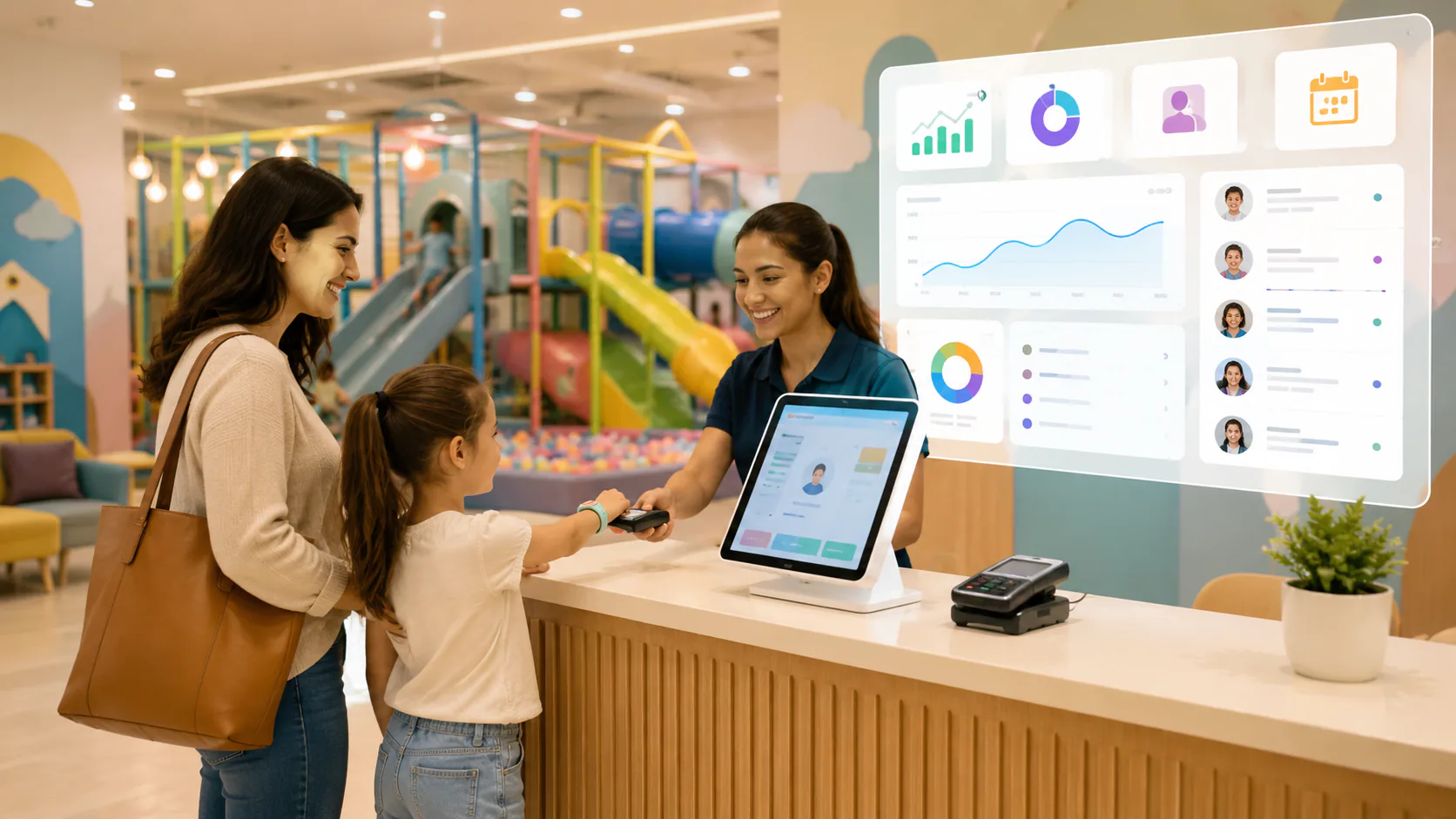
True automation is not simply about digitizing forms. Its real value emerges when customer information, check-in, payments, reservations, and daily operations are connected within a single integrated workflow.
Playground Automation and CRM: A Guide to Managing Indoor Play Centers and Kids’ Entertainment Venues
Managing an indoor playground, playhouse, or kids’ entertainment venue involves much more than selling tickets and recording entry. A modern venue may need to manage customer and child profiles, check-in and check-out, payments, reservations, staff, equipment, messaging, discounts, and operational reporting at the same time.
As the number of customers, services, or branches grows, relying on separate applications, spreadsheets, manual records, or operator-dependent processes can lead to errors, duplicate work, and poor visibility across the business.
Playground automation is designed to bring these processes together. A good playground management software platform can centralize customer information and day-to-day operations in one system and give managers a clearer view of what is happening across the venue.
Customer relationship management is also important. A playground CRM should not be treated as a simple contact list. Families often return multiple times, and the history of visits, purchases, reservations, credits, and communication can help a venue provide better service and build stronger customer relationships.
What Is Playground Automation?
Playground automation refers to the use of software, connected devices, and digital workflows to manage the daily operations of an indoor playground, playhouse, or kids’ entertainment venue.
The goal is not simply to replace paper forms with digital forms. A useful automation system should connect different parts of the operation.
For example, registering a customer can be connected to creating a child profile, assigning an RFID card or tag, purchasing a service, completing payment, checking the child in, tracking the visit duration, using stored credit, sending notifications, and keeping a complete visit history.
In an integrated system, this information is not stored in separate places. Managers can see a more complete picture of both customer activity and venue operations.
Why Does Traditional Playground Management Become Difficult?
In a small venue, it may initially be possible to manage operations with spreadsheets, handwritten records, and a few separate applications.
As customer volume grows, however, the weaknesses of this approach become more visible.
A customer’s information may be stored in several different places. A child’s previous visits may not be easy to find. Reservations may not be connected to the front desk. Sales records may not fully match payments at the end of the day.
For multi-branch businesses, the problem becomes even more complex because each location needs to operate independently while management still needs a consolidated view across all branches.
Playground automation can reduce this dependency on disconnected and manual processes.
Which Playground Operations Can Be Automated?
A large part of the daily operation of an indoor playground, playhouse, or children’s entertainment center can be managed through an integrated system.
Customer and Child Check-In
Check-in is one of the most frequent processes in a kids’ entertainment venue.
Playground management software can store parent and child information and identify returning customers through a mobile number, card, or RFID tag.
This avoids re-entering the same information during every visit and can make the front-desk process faster.
Managing Child Entry and Exit
Accurate check-in and check-out times are especially important when services are priced according to the duration of a child’s stay.
The system can record entry time, active session duration, extensions, service completion, and exit time.
This information can also be used in financial and operational reports.
RFID Cards and Tags
RFID can be used to identify customers or children quickly inside the venue.
Each child can be assigned a card or tag linked to their profile.
Depending on the business model, RFID can be used for identification, entry control, stored credit, or other venue services.
Sales Wallets and Payments
Playground management software can support different service and pricing models.
For example, a venue may offer timed sessions, fixed-price entry, prepaid packages, stored-value credit, or other service combinations.
Where required, the system can also manage customer wallets or account credit.
Integration with PC POS terminals can simplify payment processing and reduce manual data entry.
Birthday School and Group Reservations
Group reservations can represent an important part of revenue for many entertainment venues.
Birthday parties, school visits, kindergarten groups, educational programs, and other events can be managed in the same system.
Information such as date, time, number of guests, selected services, price, deposit, and reservation status can be stored centrally.
Self-Service Kiosks
Busy venues may experience queues at the reception desk during peak hours.
A self-service kiosk can move part of the check-in process directly to the customer.
Customers may be able to identify themselves using a mobile number or RFID, select or register their children, choose a service, complete payment, and receive an entry receipt without requiring every step to be handled by a front-desk operator.
What Is a Playground CRM?
CRM stands for Customer Relationship Management.
A playground CRM has some important differences from a general-purpose CRM platform.
In a kids’ entertainment venue, a customer is usually not just a name and phone number. One parent may have multiple children, and each child may have a separate visit history, purchased services, stored credit, reservations, and other operational data.
A useful playground CRM should therefore reflect the real relationship between parents, children, and venue services.
It can keep information such as visit history, purchases, reservations, credit, messages, and customer interactions in one centralized record.
Customer Management for Playgrounds and Playhouses
Customer management is one of the most important parts of a playground or playhouse management system.
When customer data is stored in a structured way, returning visits can be handled more quickly and the business can gain a clearer understanding of customer behavior.
For example, the system may show how often a family visits, which services they purchase, what reservations they have made, and whether they have remaining credit.
For venues where repeat customers are an important source of revenue, this information can be particularly valuable.
What Should Playground Customer Management Software Include?
Playground customer management software should do more than store names and phone numbers.
Useful capabilities may include:
Parent and child profiles
Visit history
RFID card or tag assignment
Wallet and stored credit management
Purchase history
Reservation management
Birthday school and kindergarten bookings
Discount management
SMS or messaging
Customer communication records
Identification of frequent customers
Customer behavior and visit reports
Keeping this information in one system can simplify both check-in and customer service.
What Is the Difference Between Playground CRM and Playground Management Software?
CRM mainly focuses on customer information, customer history, communication, and customer behavior.
Playground management software has a broader operational role.
In addition to CRM functions, it may include check-in and check-out, sales, payments, reservations, staff management, equipment maintenance, and financial or operational reporting.
In an integrated solution, playground CRM is often more effective as part of the broader management platform rather than as a completely separate system.
What Is the Difference Between Playground Software and Accounting Software?
Accounting software is designed to manage financial records, accounts, and accounting reports.
Playground management software focuses on operational processes.
For example, it may need to know which child entered the venue, which service was purchased, how long the child stayed, which RFID tag was assigned, whether there is an active reservation, and whether the customer has stored credit.
Accounting software and playground management software can work alongside each other, but they usually solve different problems.
Staff and Shift Management
Employees in different parts of a venue may work in different shifts.
A management platform can help define staff, plan shifts, and record operational information related to employee activity.
For multi-branch entertainment businesses, knowing which branch and shift each employee is assigned to can become even more important.
Equipment and Maintenance Management
Indoor playgrounds and entertainment venues often contain a large number of play structures, devices, and other equipment.
Recording faults and tracking repairs can help improve maintenance management.
Instead of keeping maintenance notes in separate spreadsheets or paper records, each piece of equipment can have a history of reported issues and repair status.
Messaging and Customer Communication
Messaging can be used for many parts of customer communication.
For example, a system can automatically send messages related to reservations, transactions, notifications, or other operational events.
When combined with customer data inside the playground CRM, messaging can also support more targeted communication with families.
Financial and Operational Reporting
Managers need reliable information to make decisions.
Reports on check-ins, sales, payments, reservations, services, and branch performance can provide a clearer view of business activity.
End-of-day reconciliation is also important.
When sales and payment information are recorded in the system, it becomes easier to compare recorded transactions with the amounts actually received.
Managing Multi-Branch Playgrounds
A multi-branch entertainment business requires a different management structure from a single-location venue.
Each branch needs to carry out its own daily operations, while central management needs visibility across all locations.
A suitable platform can manage reports, customers, services, and settings according to the branch structure of the business.
Centralized customer data can also make it easier for customers to visit different branches, depending on the company’s policies and system configuration.
Is Playhouse Software Different from Playground Management Software?
Many of the operational requirements of indoor playgrounds, playhouses, and kids’ activity centers are similar.
They may all need customer registration, child entry and exit management, reservations, payments, messaging, and reporting.
The details of the workflow, however, can differ.
A playhouse may place more emphasis on session duration and parent-child information, while a larger entertainment venue may have more services, equipment, pricing models, and branches.
For this reason, the software should be configurable and customizable according to the actual business model.
What Should Kids’ Entertainment Management Software Offer?
Choosing software should not be based only on the number of features.
What matters more is whether those features match the real operational workflow of the venue.
Important considerations may include:
Ease of use for operators
Fast customer check-in
Parent and child management
RFID support
Payment and sales management
Reservation management
Integration with external devices
Useful management reporting
Multi-branch support
Customization and extensibility
Flexible deployment options
Cloud or On-Premises Deployment?
Playground management software can be deployed in different ways.
With cloud deployment, the system runs on cloud infrastructure and branches connect to it over the network.
Some organizations may prefer an on-premises server because of internal policies, technical requirements, or security considerations.
The right choice depends on branch count, network quality, security policies, infrastructure costs, and operational requirements.
Integrating Playground Software with External Devices
A practical management system often needs to communicate with equipment already used inside the venue.
Depending on the implementation, integrations may include:
RFID cards and tags
PC POS terminals
Receipt printers
Self-service kiosks
SMS services
Shopping mall sales reporting systems
These integrations can reduce manual data entry and simplify everyday operations.
Why Does Real-World Software Operation Matter?
Many software problems only become visible during real operation.
Peak-hour check-in, high customer volumes, operator mistakes, payment discrepancies, reporting requirements, and changes in business processes may not be fully discovered during short testing periods.
For this reason, real-world operational experience can be an important part of the maturity of a playground management platform.
Software that has been used for an extended period in a real entertainment venue has had more opportunity to encounter practical problems and refine its workflows.
BaziYar Playground Management and CRM System
BaziYar is an integrated management system designed to cover a large part of the daily operations of indoor playgrounds, playhouses, and kids’ entertainment venues.
The platform includes customer and child management, check-in and check-out, RFID, wallets, sales and payments, reservations, self-service kiosks, staff management, equipment tracking, messaging, and management reporting in one centralized environment.
BaziYar is designed for both single-location and multi-branch businesses and can be deployed on cloud infrastructure or on the venue’s own server.
The system has been used operationally for more than a year and a half in a two-branch entertainment business, and a significant part of its features and workflows have been shaped by real operational needs and management challenges.
For more information about the system and its capabilities, visit the BaziYar playground management software page.
Frequently Asked Questions About Playground Automation and CRM
What is playground automation?
Playground automation is the use of an integrated system to manage processes such as customer check-in, child entry and exit, sales, payments, reservations, customer management, staff, and management reporting.
Its main purpose is to reduce manual work and connect different operational processes.
What is a playground CRM?
A playground CRM is a customer management system designed for the specific needs of indoor playgrounds and kids’ entertainment venues.
It can store parent and child information, visit history, purchases, reservations, credit, and customer communication records.
In a complete solution, CRM is often one part of the broader playground management system.
What does playground customer management software do?
It stores customer, child, and visit information in a structured way.
It can also support purchase history, stored credit, reservations, messaging, and identification of frequent customers.
Is playground management software suitable for playhouses and kids’ activity centers?
In many cases, yes.
Playhouses and kids’ activity centers share many of the same needs, including customer management, child entry and exit, payments, reservations, and communication.
The system should still be configurable to match the specific workflow of each venue.
Can RFID be used with playground management software?
Yes, when supported by the system.
RFID cards or tags can be assigned to customers or children and used for identification, check-in, entry control, stored credit, or other services.
Can playground software manage birthday reservations?
Yes.
A suitable management system can manage birthday parties, school groups, kindergarten visits, and other events.
Details such as date, time, guest count, selected services, price, and reservation status can be stored centrally.
What is the difference between playground software and accounting software?
Accounting software focuses on accounts and financial records.
Playground management software focuses on operational processes such as check-in, child entry and exit, RFID, reservations, and customer management.
The two systems can be used together.
Can playground management software support multiple branches?
Yes, when the platform is designed for multi-branch operation.
Each branch can manage its daily operations while central management can review the information and reports it needs across multiple locations.
What information can a playground customer management system store?
Depending on the platform, it may store parent and child information, contact details, visit history, purchased services, stored credit, reservations, RFID assignments, and customer communication history.
Conclusion
Managing an indoor playground, playhouse, or kids’ entertainment venue involves many connected operational processes.
Using disconnected tools can make these processes difficult to control as the business grows.
Playground automation can bring check-in, entry and exit, sales, payments, reservations, staff, equipment, customer management, and reporting together in one system.
At the same time, playground CRM can help venues maintain a useful history of family visits and customer interactions.
Playground customer management software delivers the most value when customer information is integrated with real operational workflows rather than managed as a separate contact database.
For venues dealing with high customer volumes, reservations, payments, or multiple branches, an integrated management platform can simplify day-to-day operations and provide managers with more accurate information for decision-making.
To explore a practical solution in this area, visit BaziYar playground management software for indoor playgrounds, playhouses, and kids’ entertainment venues.
BlogIn entertainment venues, the main challenge is usually not a lack of software; it is fragmented information and disconnected processes.
Amirhossein Diyari — Systems Analyst & Developer
Related articles
Related articles
Work with TortakTech Modern Technology Engineering Group
Ready to turn an idea into a practical solution?
Connect with the TortakTech Modern Technology Engineering Group team to explore your needs, ideas, and the right path to delivery.